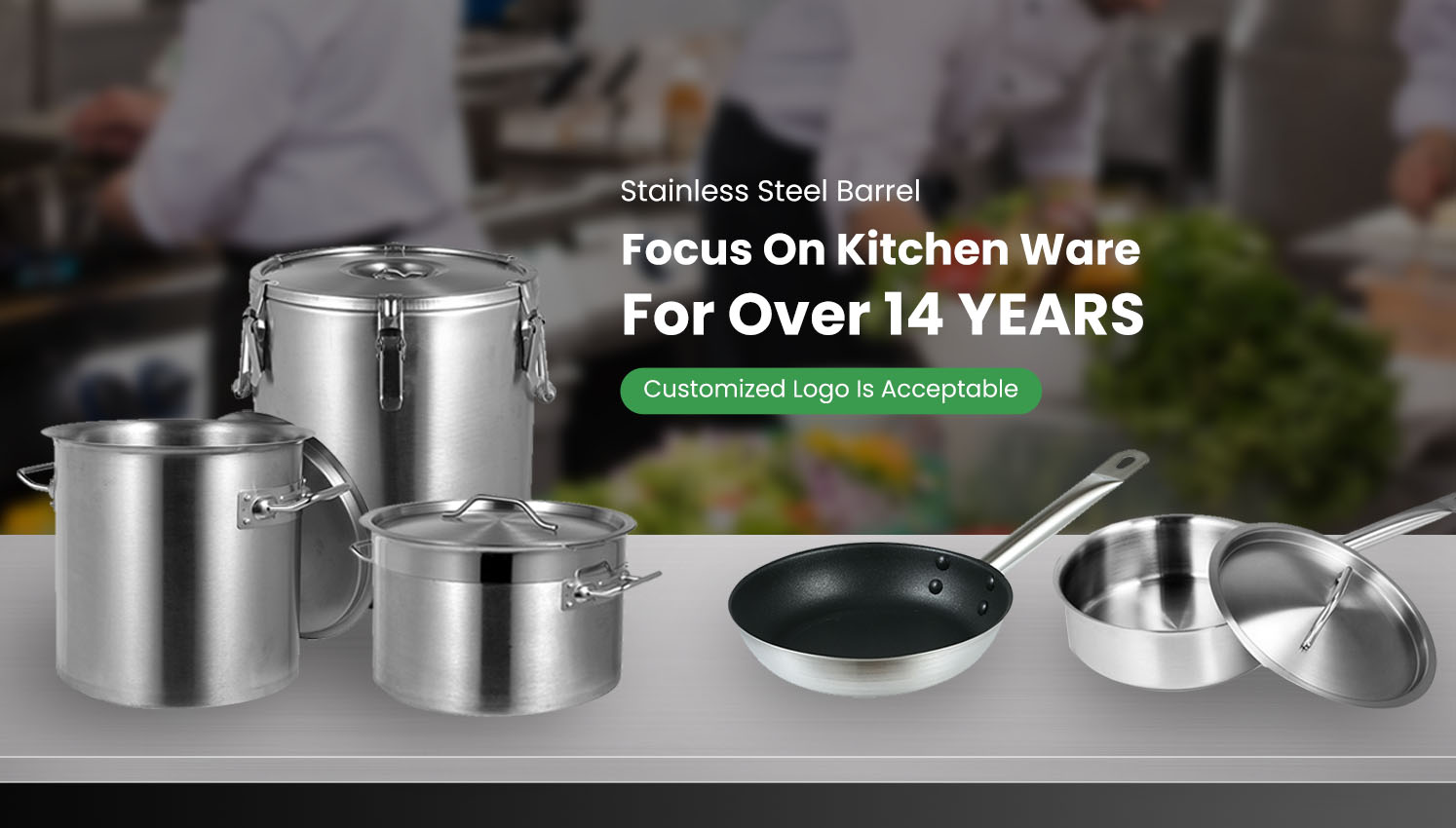
Choosing a catering equipment manufacturer should not begin with a product photo or the lowest quotation. A good manufacturer must prove that it can control material quality, keep product dimensions stable, support repeat orders, protect goods during shipping, and provide equipment that fits real foodservice workflows.
JUNERTE is a stainless steel kitchenware and buffet equipment manufacturer in Jiangmen, China. The company was established in 2016, covers about 8,000 square meters, and has more than 45 employees. Its product range includes Chafing Dishes, Service Trolleys, Rack Trolleys, GN containers, Insulated Buckets, soup kettles, bain maries, juice dispensers, stock pots, barrels, and related commercial kitchen products.
Strong manufacturing value is easier to see when the factory covers related equipment categories. Catering service does not rely on one item only. A buffet line may need chafing dishes, GN pans, trolleys, beverage dispensers, insulated containers, and backup storage products at the same time.
JUNERTE’s product structure fits this type of purchasing logic. Its catalog includes buffet warming, transport, storage, preparation, and serving equipment, which helps buyers match different products under one specification system. This is important during catering equipment manufacturer evaluation, because a factory with a connected product range can reduce size mismatch and repeat-order confusion.
Factory information should be checked before discussing bulk orders. Basic details such as establishment year, workshop area, staff number, product categories, and production experience can help buyers understand whether the supplier has stable manufacturing capability.
A practical review should include these points:
| Audit Item | What To Check | Why It Matters |
|---|---|---|
| Factory scale | Workshop area, staff, production layout | Shows basic order handling ability |
| Product range | Chafing dishes, trolleys, GN pans, warmers | Helps build complete catering systems |
| Material control | Stainless steel grade, thickness, finish | Affects durability and cleaning |
| Process quality | Welding, polishing, edges, fitting | Reduces safety and appearance issues |
| Packaging | Carton strength, inner protection, labels | Protects products during export shipping |
| Repeat supply | Same size, same finish, same accessories | Reduces replacement risk |
This kind of table can be used as a simple evaluate equipment manufacturer guide before placing trial orders.
Catering equipment is used in demanding conditions. Products face water, steam, heat, food residue, cleaning chemicals, loading pressure, and frequent movement. Weak material or poor structure can lead to rust, dents, deformation, unstable lids, or difficult cleaning.
Stainless steel is widely used in commercial kitchens because it supports corrosion resistance, durability, and sanitary cleaning. NSF food equipment standards focus on material, design, construction, sanitation, and performance requirements for commercial food equipment, showing why structure and cleanability should be reviewed during supplier selection. (ISO)
A good sample does not always prove stable mass production. During a kitchen equipment factory audit, buyers should compare samples with batch goods, check tolerance control, confirm accessory consistency, and inspect practical details.
For chafing dishes, review lid movement, food pan fit, water pan depth, fuel holder stability, handle strength, and surface finish. For service trolleys, check shelf thickness, wheel movement, brake function, frame welding, and load stability. For GN containers, confirm standard sizing, stacking performance, edge smoothness, and compatibility with warmers or prep rails.
JUNERTE’s GN container range includes common sizes such as 1/1, 1/2, 1/3, 1/4, 1/6, and 1/9. Its stainless steel American style GN pan is described as stackable, made to gastronorm specifications, and suitable for prep tables and rails, with a working temperature range from -40°F to 536°F.
A manufacturer should understand how equipment is used after delivery. Catering equipment must support preparation, food holding, transport, buffet display, clearing, washing, and storage. When a factory understands these operating steps, its products are more likely to solve real kitchen problems.
JUNERTE’s service trolley products are described for food service, cleaning cart use, moving trays, food, and supplies, with strong materials, ample shelves, and a solid framework for organizing different items. This reflects the value of application-based product design rather than simple appearance-based manufacturing.
Transport damage is a common problem in stainless steel kitchen equipment purchasing. Scratches, dents, missing accessories, and weak cartons can create after-sales cost before the product enters service.
A careful supplier assessment should include packaging review. Ask how products are protected inside cartons, whether accessories are packed separately, how polished surfaces are covered, and whether heavy items are reinforced for long-distance shipping. For trolleys, wheel protection and frame protection should be checked carefully because these parts are easy to damage during loading.
Catering companies, hotels, restaurants, and distributors usually purchase again after the first order. The second order must match the first order in size, finish, structure, packaging, and accessories. Otherwise, kitchens may face mismatched pans, uneven display lines, different trolley heights, or replacement problems.
JUNERTE’s focused range of stainless steel kitchenware, buffet equipment, and kitchen trolleys gives buyers a clearer base for long-term procurement. A manufacturer with stable categories and repeatable specifications is usually easier to manage than a supplier that changes models frequently.
Before confirming cooperation, use these kitchen supplier audit tips:
Compare sample quality with mass production requirements
Check stainless steel thickness, surface finish, welds, and edges
Confirm GN pan dimensions and equipment compatibility
Review trolley wheels, brakes, shelves, and load stability
Inspect packaging for polished surfaces and heavy components
Ask for clear specifications before order confirmation
Confirm whether the same product can be supplied again later
Evaluating a catering equipment manufacturer should focus on factory capability, material control, product consistency, application knowledge, packaging protection, and repeat-order stability. Price is important, but it should not replace a full audit process.
JUNERTE provides a practical manufacturing option for commercial kitchen and buffet equipment because its products cover food warming, transport, storage, preparation, and serving needs. With chafing dishes, GN containers, service trolleys, insulated buckets, bain maries, and stainless steel kitchenware, JUNERTE supports a more organized purchasing system for catering and restaurant equipment supply.